
As an Amazon Associate, WrenchWizardAI earns from qualifying purchases. Some links below are affiliate links.
P0420 Code Explained: Real Causes, Quick Tests, and How to Avoid Replacing the Wrong Part
A P0420 trouble code (“Catalyst System Efficiency Below Threshold”) is one of the most misunderstood check-engine codes. A lot of people hear “catalytic converter” and immediately spend $800–$2,500… only to find out the real problem was an exhaust leak, a lazy O2 sensor, or even a misfire.
This guide breaks down what P0420 actually means, the most common real-world causes, and a step-by-step test plan that helps you confirm the fix before you throw parts at it.
What P0420 actually means (in plain English)
Your car’s computer compares the upstream (front) oxygen sensor and downstream (rear) oxygen sensor signals. A healthy catalytic converter smooths out exhaust chemistry fluctuations, so the rear sensor signal should be steadier than the front.
When the ECU sees the rear sensor behaving too much like the front (for long enough, under specific driving conditions), it flags P0420.
Key point: P0420 is a system efficiency code. It’s not a guaranteed “replace the cat” message.
The most common causes of P0420 (ranked by “most likely”)
1) Exhaust leak (especially before the rear O2 sensor)
Small leaks at the flex pipe, manifold gasket, or flange can let extra oxygen into the exhaust stream and confuse sensor readings.
2) Aging downstream O2 sensor (lazy/slow response)
A rear sensor that’s slow or drifting can mimic a bad converter.
3) Engine misfire, fuel trim issues, or running rich
Unburned fuel overheats and damages converters over time. Even if the misfire is intermittent, it can set you up for P0420 later.
4) Coolant or oil burning
A leaking head gasket, worn rings, or valve seals can contaminate the catalyst.
5) Catalytic converter truly worn out
Yes, it happens—especially on higher mileage vehicles or cars that have run rich/misfired for a while.
Quick “don’t be a victim” checklist (do this first)
Before you test anything:
- Is your check engine light flashing? If yes, stop driving and fix the misfire first.
- Are there other codes besides P0420 (P0300–P030X misfires, fuel trim codes, O2 sensor codes)? Fix those first.
- Did you recently hit something that could’ve damaged the exhaust?
- Do you smell exhaust, hear ticking, or see soot near joints?
Tools that make this diagnosis 10x easier
A basic scanner is enough to pull codes and (ideally) view freeze-frame and readiness monitors.
- ANCEL AD310 OBD2 Scanner (affiliate):
(This model shows strong review volume and rating on Amazon.ca: 4.6/5 with 57,903 ratings.)
If you end up replacing an O2 sensor, a dedicated socket saves knuckles and time:
- O2 Sensor Socket Tool (affiliate):
(Well-reviewed on Amazon.ca: 4.4/5 with 2,676 ratings.)
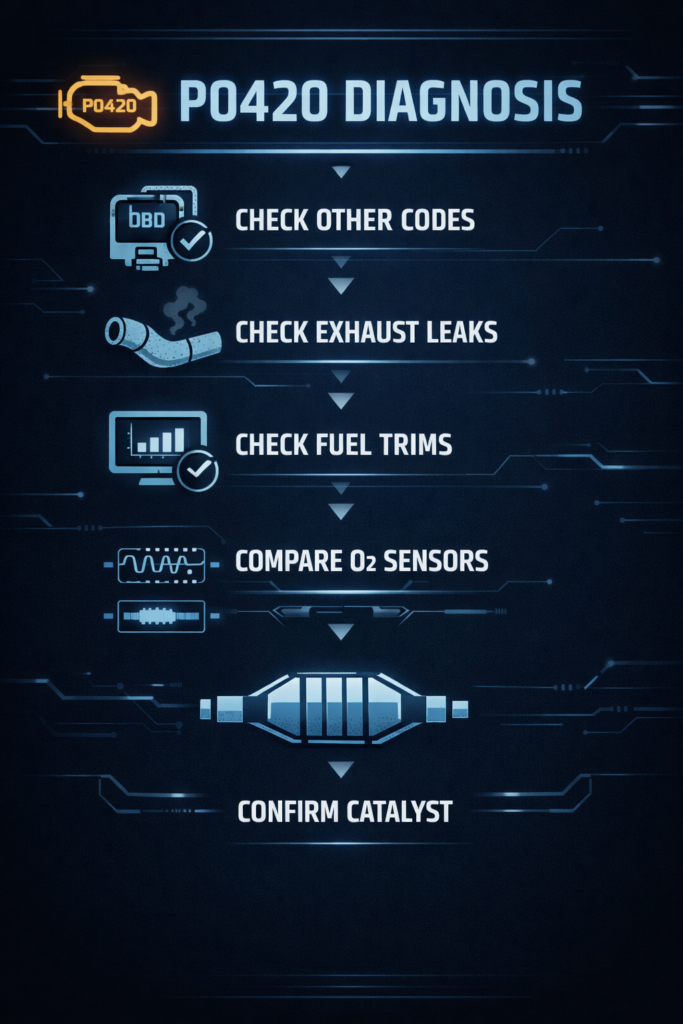
Step-by-step P0420 test plan (DIY-friendly)
Step 1: Pull codes + freeze-frame
Freeze-frame tells you when the code set (coolant temp, RPM, speed, fuel trims). If P0420 sets during steady cruise when the engine is warm, that’s typical.
Step 2: Check readiness monitors
If you recently cleared codes, monitors may be incomplete. P0420 diagnosis is easier when monitors have run naturally.
Step 3: Inspect for exhaust leaks (visual + sound)
- Look for black soot streaks at joints.
- Listen for ticking at cold start near the manifold or flex pipe.
- Check hanger integrity—stress cracks are real.
DIY “graphic” (quick checklist box):
Exhaust leak hotspots
- Manifold gasket
- Flex pipe braid
- Flange gaskets (spring-bolt joints)
- Weld seams near resonator/muffler
- Clamp connections
Step 4: Look at O2 sensor behavior (basic live data idea)
If your scanner shows live data:
- Upstream O2 should switch rapidly (normal closed-loop behavior)
- Downstream O2 should be steadier on a healthy cat
If downstream switches rapidly like upstream, either:
- the cat isn’t storing oxygen well, or
- there’s a leak/sensor skew causing a false read
Step 5: Check fuel trims (quick sanity check)
High positive fuel trims can indicate vacuum leaks (lean condition), while rich conditions can damage the cat.
Step 6: If you suspect a misfire/rich condition, fix that first
A converter can’t “win” if the engine is dumping fuel into it.
When the catalytic converter is actually the problem
The converter becomes the likely culprit when:
- No exhaust leaks are found
- No misfire/fuel trim issues exist
- Sensors test good (or you have strong evidence they’re behaving normally)
- P0420 keeps returning after a full drive cycle
What to do next (the smartest move)
If you want the fastest path without guessing, do this:
- Scan codes + freeze-frame
- Note symptoms (power loss, smell, rattling, mpg change)
- Run the checklist above
- Ask WrenchWizardAI for a prioritized plan using your exact vehicle info
✅ Start your free diagnosis here: https://wrenchwizardai.com/diagnosis/ Wrench Wizard AI
Related reading on WrenchWizardAI (internal links)
- OBD2 Codes Explained: https://wrenchwizardai.com/obd2-codes-explained-check-engine-light/ Wrench Wizard AI
- How AI Helps Diagnose Faster: https://wrenchwizardai.com/ai-auto-repair-2025/ Wrench Wizard AI
- Diagnostics category: https://wrenchwizardai.com/category/diagnostics/ Wrench Wizard AI
- Blog home: https://wrenchwizardai.com/blog/ Wrench Wizard AI
- Pricing (upgrade to Pro): https://wrenchwizardai.com/pricing/ Wrench Wizard AI