
As an Amazon Associate, WrenchWizardAI earns from qualifying purchases. Some links below are affiliate links.
Car Won’t Start? Battery vs Starter vs Alternator (DIY Decision Tree)
“No start” is one of the most frustrating car problems—because the symptom is simple, but the causes aren’t. The good news: you can usually narrow it down in minutes using a few quick observations and one or two basic tests.
This guide gives you a clear decision tree to diagnose whether the issue is:
- Battery / cables
- Starter / relay / solenoid
- Alternator / charging system
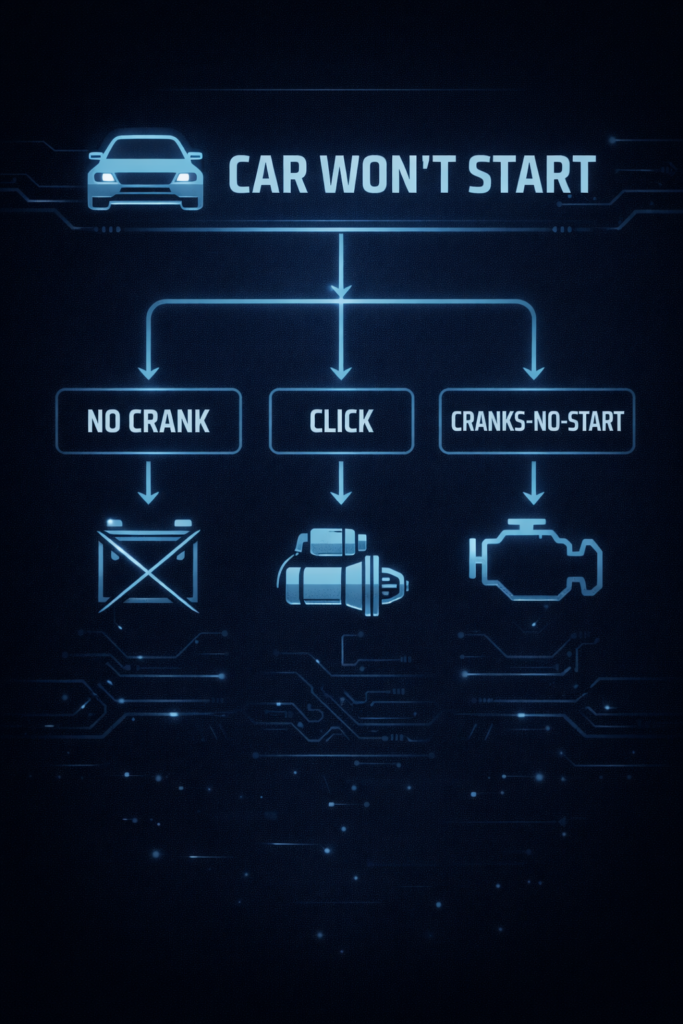
First, identify which “no-start type” you have
A) No crank (silence)
You turn the key and… nothing. No click. No crank.
B) Click but no crank
You hear a rapid click or a single click, but the engine doesn’t turn.
C) Cranks but won’t start
The engine spins normally but never fires.
This article focuses on A & B, which are most often battery/starter/charging related.
The 60-second decision tree (pasteable “graphic”)
NO-START DECISION TREE
- Do headlights/dash lights look normal?
- Very dim/dead → Battery/cables most likely
- Normal bright → go to step 2
- What sound do you hear when starting?
- Rapid clicking → weak battery or poor cable connection
- Single click → starter/solenoid/relay or bad ground
- Silence → battery connection, ignition switch, relay, neutral safety, or dead battery
- Can you jump-start it?
- Yes → battery weak OR alternator not charging
- No → starter circuit problem or severe connection issue
Tools that make diagnosis way easier
1) Jump starter (saves you from waiting for another car)
- NOCO Boost GB40 (affiliate):
(Very high review volume on Amazon.ca: 4.5/5 with 118,249 reviews.)
2) Multimeter for voltage drop + charging checks
- AstroAI Digital Multimeter (affiliate):
(Well-reviewed on Amazon.ca: 4.5/5 with 5,973 ratings.)
3) Optional: battery + alternator analyzer (quick results)
- ANCEL BA101 Battery Tester (affiliate):
(Well-reviewed on Amazon.ca: 4.4/5 with 3,465 ratings.)
Step-by-step diagnosis (battery → starter → alternator)
Step 1: Battery basics (don’t skip this)
Open the hood and check:
- Corrosion on terminals (white/green crust)
- Loose clamps (you should not be able to twist by hand)
- Ground cable tight to chassis/engine
Pro tip: Many “starter” problems are actually bad grounds.
Step 2: Measure battery voltage (key off)
- 12.6V = fully charged
- 12.2V = ~50%
- 12.0V or lower = likely too weak to crank
If you’re under ~12.2V, charge the battery or jump it and retest.
Step 3: Voltage drop test (quick DIY version)
Have someone crank while you watch voltage:
- If voltage drops below ~10V while cranking, the battery is weak or there’s high resistance in cables.
Step 4: Jump-start result tells a story
If jump-start works:
- Your starter can crank
- The battery is weak or the alternator isn’t charging
If jump-start does not work:
- starter/relay/solenoid/ground issue is more likely
Step 5: Starter clues
Symptoms that point to starter circuit:
- Single solid click from starter area
- Dash lights stay bright but no crank
- Starter works intermittently (heat soak issues)
Step 6: Alternator check (engine running)
If you can get it running:
- Measure at battery with engine idling:
- 13.8–14.6V typical charging range
- 12.6V-ish while running → alternator may not be charging
“Cranks but won’t start” (quick note)
If it cranks strongly but won’t fire, you’re in fuel/spark/compression territory—different diagnosis path.
A basic scanner helps here:
- ANCEL AD310 OBD2 Scanner (affiliate): https://www.amazon.com/dp/B01G5EA74I/?tag=wrenchwizarda-20 Amazon Canada
Call-to-action (make this even faster)
If you want a guided plan tailored to your exact situation, submit:
- Year/make/model
- Whether it’s silence/click/crank
- Battery voltage (if you have it)
- Any dash messages
✅ Start your free diagnosis: https://wrenchwizardai.com/diagnosis/ Wrench Wizard AI
Or upgrade for real-time back-and-forth: https://wrenchwizardai.com/pricing/ Wrench Wizard AI
Related reading (internal links)
- Diagnostics category: https://wrenchwizardai.com/category/diagnostics/ Wrench Wizard AI
- OBD2 Codes Explained: https://wrenchwizardai.com/obd2-codes-explained-check-engine-light/ Wrench Wizard AI
- AI Auto Repair 2025: https://wrenchwizardai.com/ai-auto-repair-2025/ Wrench Wizard AI
- Blog home: https://wrenchwizardai.com/blog/ Wrench Wizard AI
- Contact: https://wrenchwizardai.com/contact/ Wrench Wizard AI